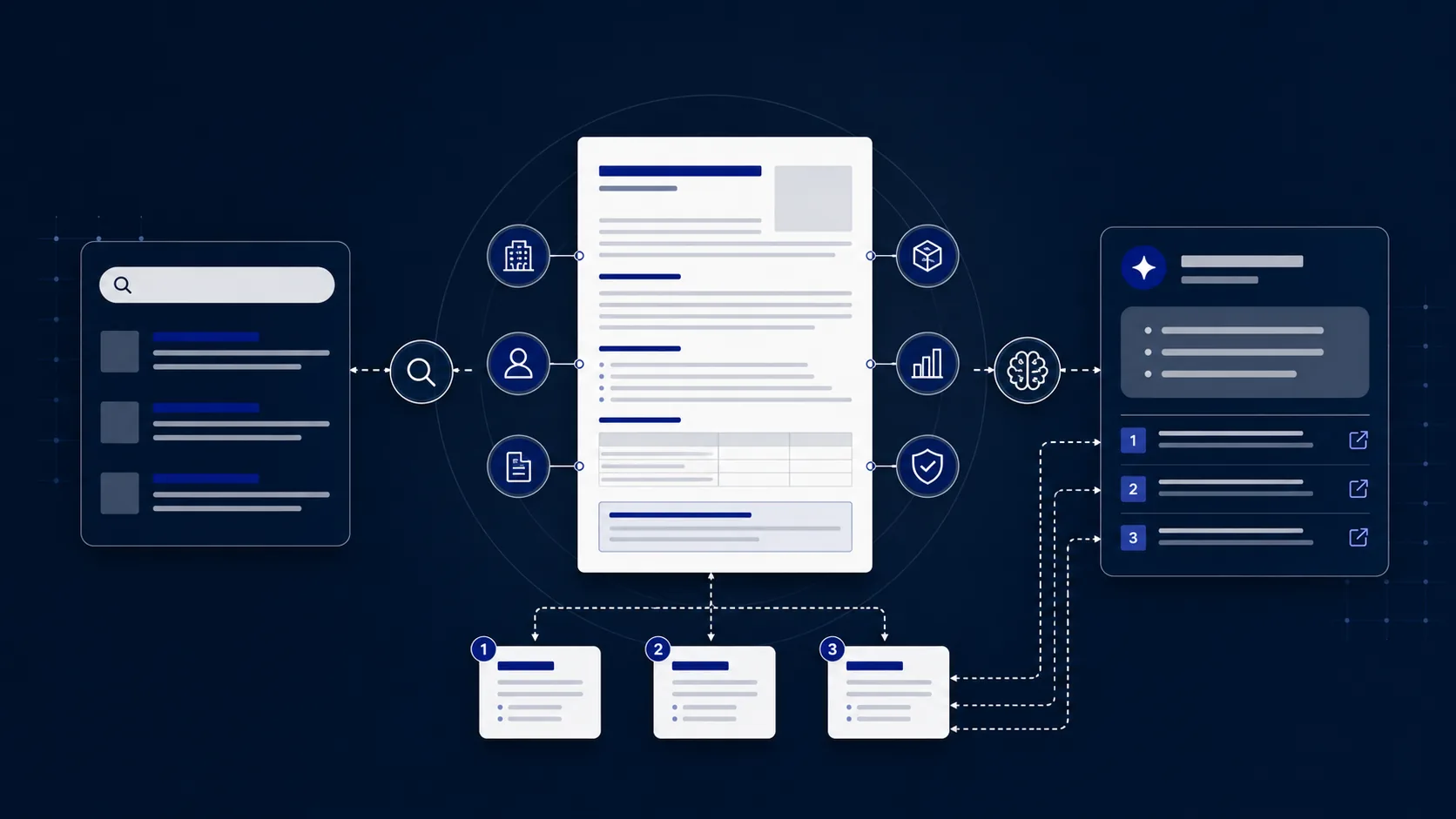
Search and AI-assisted discovery increasingly overlap. Buyers still use conventional search results, but they also ask complex questions in AI search experiences that assemble information from multiple sources.
For a B2B company, the useful question is not whether to choose SEO or GEO. The question is whether the website contains accurate, accessible, well-structured information that both people and discovery systems can understand.
GEO starts with search fundamentals
Google states that the same SEO foundations apply to AI features in Search. There is no additional technical requirement or special schema that guarantees appearance in an AI Overview or AI Mode. Important pages still need to be indexed, eligible for a snippet, and genuinely useful.
- Allow appropriate crawling through robots and hosting controls.
- Make important pages discoverable through internal links.
- Keep essential information available as visible text.
- Use structured data that matches the page visitors can read.
- Maintain a strong mobile and page experience.
That makes GEO an extension of responsible search work rather than a separate technical shortcut.
Make the business entity unambiguous
A discovery system should not need to infer the company name, legal identity, services, audience, location, or contact information from contradictory pages. Use consistent company details, service definitions, author information, and internal links. Connect every important service to supporting insight and every insight to a relevant commercial next step.
Structured data can reinforce these visible facts through Organisation, WebSite, WebPage, Service, BreadcrumbList, and article markup. It should not contain hidden claims, invented ratings, or unsupported proof.
Write passages that answer real buyer questions
Answer-first content begins with a useful conclusion and then provides definitions, context, trade-offs, process, evidence, and next actions. This makes the page easier for a buyer to scan and gives search and AI systems clearer passages to understand.
Useful B2B content should reflect genuine subject-matter knowledge. It should explain how a decision is made, what information is required, what can go wrong, and where the limits are. Creating many shallow pages around slightly different keywords usually weakens the site rather than building authority.
Use sources and authorship accurately
When a factual statement depends on external evidence, link to the primary source. Show a real publication date, updated date, author or organisation, and review information only when it is accurate. The objective is not to decorate a page with trust signals; it is to make the information inspectable.
Measure discovery as part of the commercial journey
Track impressions and organic visits, but also measure qualified landing-page engagement, conversion actions, enquiries, and commercial quality. OpenAI notes that ChatGPT search referrals include utm_source=chatgpt.com, which allows those visits to be reviewed alongside other acquisition sources.
No provider can guarantee rankings, traffic, AI citations, or inclusion. A responsible programme improves the technical, editorial, and entity foundations that make discovery possible, then learns from evidence over time.
A practical B2B SEO/GEO checklist
- Confirm that priority pages can be crawled, indexed, and rendered with their full content.
- Define the buyer questions and commercial topics the business can answer credibly.
- Strengthen service pages with direct definitions, scope, process, limitations, and FAQs.
- Publish supporting insights with clear authorship and primary sources.
- Connect related pages through descriptive internal links.
- Keep company details and entity signals consistent.
- Measure visibility, conversion, and commercial quality together.
Aktyvus Group combines these foundations into an integrated search and inbound conversion system rather than treating SEO and GEO as isolated content production.