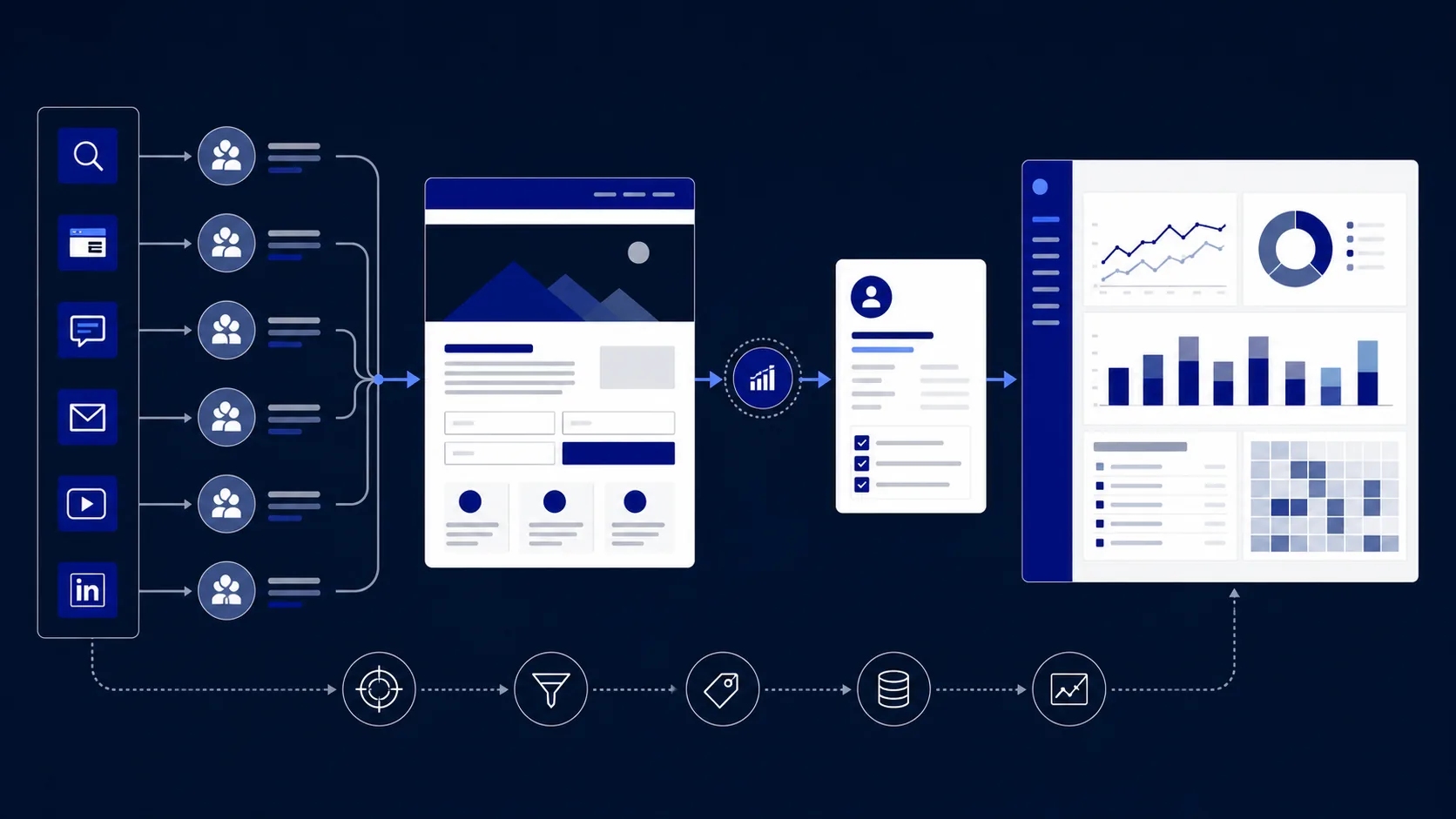
Paid media magnifies the system it enters. If positioning is unclear, the landing page is generic, or conversion tracking is incomplete, additional spend creates more activity without reliable learning.
A media-buying programme should therefore begin with readiness: a credible offer, defined audience, message fit, usable destination, measurable conversion action, and capacity to respond.
Define the conversion before the campaign
Choose the business action the campaign should create. That may be a qualified consultation request, a relevant enquiry, a phone conversation, or another meaningful step. Google Ads recommends defining separate conversion actions for different valuable outcomes rather than treating every interaction as equivalent.
Clicks, impressions, and page views are diagnostic inputs. They are not substitutes for a commercial conversion.
Keep the advertisement and landing page continuous
Google describes landing-page experience through usefulness, relevance, ease of navigation, and alignment with the visitor's expectations. The buyer should immediately recognise the same audience, problem, promise, and next action after clicking the advertisement.
A broad homepage can be useful for brand exploration, but a focused campaign often needs a dedicated landing page with one clear purpose. Remove unrelated choices, answer the likely objections, explain the process and limitations, and make the conversion action obvious.
Select channels around the buying situation
- Google Search can capture active demand when buyers are already looking for a solution.
- LinkedIn Ads can reach professional audiences through role, company, industry, and account context.
- Meta advertising may fit some B2B or founder audiences when the offer, creative, and targeting logic support it.
The right channel depends on demand, audience access, sales cycle, creative requirements, budget, and conversion economics. Channel popularity is not a sufficient reason to spend.
Instrument the complete path
Capture campaign and UTM parameters, landing page, form completion, call activity where appropriate, and downstream commercial quality. Platform-reported conversions are useful, but they should be reconciled with the business's own enquiry and revenue records.
Define who reviews lead quality, how quickly feedback is returned, and which outcomes will change the campaign. Without that loop, optimisation is limited to platform signals.
Test with a clear hypothesis
Every test should state the audience, message, destination, conversion, budget boundary, and review window. Change one meaningful variable at a time where practical. A test that cannot explain what was learned is only spend.
Paid-media readiness checklist
- The offer and target buyer are specific enough to guide an advertisement.
- The landing page continues the advertisement's promise.
- The conversion action is useful to the business.
- Tracking records source and campaign details.
- The team can respond to enquiries quickly and consistently.
- Budgets, approval rights, and stop conditions are agreed.
- Lead quality and commercial follow-through are reviewed alongside platform metrics.
Advertising spend is separate from management fees. No responsible provider can guarantee platform approval, traffic, lead volume, acquisition cost, or sales outcomes. The objective is a better-controlled process for turning spend into evidence and relevant demand.