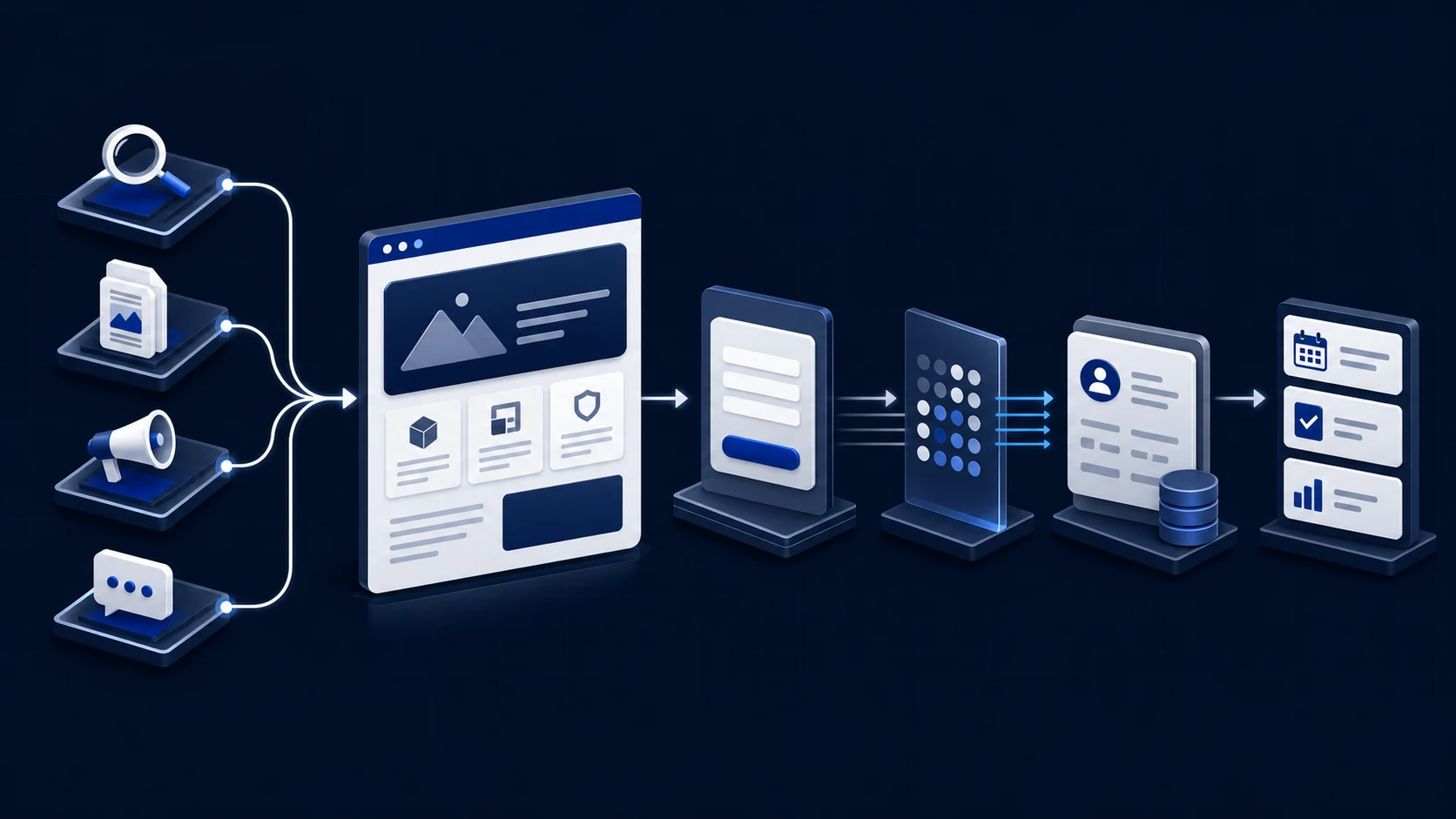
A conversion-ready website is not simply a page with a prominent button. It is a connected sequence that helps the right visitor recognise relevance, evaluate the offer, choose a sensible next action, and receive consistent commercial follow-up.
The form is only one component. Traffic quality, message continuity, information structure, proof, friction, routing, response speed, and measurement all influence whether attention becomes a useful enquiry.
Begin with the visitor's intent
A visitor arriving from a high-intent search, an educational article, a referral, or a paid campaign does not start from the same level of awareness. The page should continue the question, problem, or promise that caused the visit.
Before designing a landing page, define the likely visitor, the trigger behind the visit, what they already understand, what they still need to believe, and the next action that would be proportionate. This prevents the page from becoming a generic company brochure.
- High-intent visitors may need scope, process, fit, risk, and a direct consultation route.
- Problem-aware visitors may need a diagnosis, comparison, checklist, or example before they are ready to speak.
- Returning visitors may need proof, detail, or a clear way to continue a previous evaluation.
Keep the acquisition promise continuous
The transition from search result, advertisement, email, social post, or referral to the destination page should feel deliberate. Use the same audience, problem, promise, and terminology. A visitor should not need to reinterpret the offer after clicking.
Google's landing-page guidance emphasises usefulness, relevance, ease of navigation, and alignment with what a visitor expects. That principle applies beyond advertising: every acquisition message creates an expectation that the destination must fulfil.
Build the page around one decision
A strong conversion page answers the commercial questions that stand between interest and action. The exact order varies, but the decision normally requires the following:
- Recognition: who the service is for and which problem or opportunity it addresses.
- Value: what becomes clearer, easier, faster, or better controlled.
- Method: how the work is diagnosed, built, delivered, and governed.
- Scope: what is included, what the client provides, and where the boundaries sit.
- Credibility: real evidence, useful examples, transparent methodology, or source-backed expertise.
- Risk reduction: limitations, common objections, implementation expectations, and a low-confusion next step.
Not every page needs every section at equal length. The objective is to remove the uncertainty that prevents the right visitor from progressing.
Choose a proportionate conversion action
A complex professional service rarely needs a one-click purchase. Its primary conversion may be a consultation request, focused assessment, call, or detailed enquiry. Earlier-stage visitors may prefer a useful brief or diagnostic that lets them evaluate the problem before committing time.
The call to action should state what will happen next. "Book a free growth consultation" is clearer than "Submit" because it explains the immediate exchange. The surrounding copy should clarify who the conversation is for and what information will make it useful.
Reduce friction without removing qualification
Shorter forms are not automatically better. A form should request the minimum information required to route, qualify, and prepare a relevant response. Name and email may maximise completions but leave the team without enough context. A long internal questionnaire may suppress legitimate demand.
Use visible labels, meaningful error messages, accessible controls, a clear consent statement, and a strong confirmation state. Preserve the landing page, referrer, and campaign parameters without asking the visitor to repeat them.
Design the post-submit operating path
Conversion does not finish when the browser displays a success message. The enquiry should be stored safely, acknowledged, assigned to an owner, and connected to a response expectation. Where appropriate, a booking option can let a suitable visitor choose a time without waiting for manual coordination.
The internal process should answer four questions:
- Who owns the enquiry now?
- What makes it qualified, unqualified, or incomplete?
- When should the first useful response happen?
- Which next action will be recorded and reviewed?
Measure quality beyond form completion
Page conversion rate is useful, but it can be misleading on its own. A page can produce more submissions by attracting weaker traffic or removing necessary qualification. Review conversions alongside accepted enquiries, sales conversations, opportunities, and reasons for rejection.
Google Ads distinguishes website conversion actions and supports deeper lead stages such as qualified and converted leads. That reflects an important operating principle: the business should feed commercial quality back into acquisition decisions.
A practical conversion-architecture review
- Identify the priority visitor and the trigger behind each important traffic source.
- Check that the source message and landing-page promise are continuous.
- Write down the questions a suitable buyer must answer before taking action.
- Remove sections that do not support that decision and add missing evidence or boundaries.
- Choose a proportionate conversion action and explain what happens after it.
- Test the form, confirmation, notification, ownership, and response workflow end to end.
- Review conversion volume, qualification, progression, and commercial feedback together.
Aktyvus Group treats website conversion as part of an inbound operating system. The objective is not more form fills at any cost; it is a clearer path from relevant attention to a measurable commercial next step.